Suitability depends on the rider’s transfer ability, hand and leg function, mobility aid, route and charging arrangements—not simply on having three wheels. By checking the vehicle documents, physical dimensions, controls, road performance and recovery plan, you can decide whether a Cherry S or Cherry D supports independent daily travel or whether another accessible vehicle category is safer.
Key takeaways
- A seated wheelchair user cannot use a conventional scooty without transferring.
- Measure seat height, step-through access, controls and turning space before purchase.
- Test mobility-aid storage and stability on Pune’s slopes, potholes and traffic.
- Confirm charging, service, recovery and a complete acceptance test in writing.
Start with the rider’s transfer and physical abilities
A Cherry S or Cherry D is suitable only if the rider can get on, sit securely, control the vehicle and leave it without unavailable assistance. A conventional scooty seat requires transfer from a wheelchair, bed, standing position or walking aid; it does not accommodate a wheelchair user who remains seated.
For cherry for electric three wheeler scooty disabled riders in pune, inspect the actual vehicle and record:
- Measure step-over height, seat height, seat width, seat depth, backrest support and grab-point location using the rider’s normal footwear, brace, prosthesis and cushion.
- Test transfers with reduced leg strength, paralysis or balance impairment. Reject the vehicle if the rider cannot place both feet securely, remain stable while turning, or rise without unsafe strain.
- If the rider stays in the wheelchair, require a ramp or lift, a usable opening, wheelchair restraints, suitable anchor points and space for the feet and upper body. A photograph cannot prove these features.
- Test approaching, transferring, starting, stopping, reversing and exiting. A rider who cannot transfer independently must not approve the vehicle from the driver’s seat alone.
- Confirm whether the three-wheel layout is delta, with two rear wheels, or tadpole, with two front wheels. Check track width, centre of gravity and the manufacturer’s slope limit; three wheels do not guarantee safety during tight turns or on slopes.
Have another person observe the complete transfer and emergency exit. If daily travel depends on help that will not be available, choose a different vehicle category.
Verify the vehicle category, controls and physical specifications
A Cherry model may be a passenger tricycle, mobility scooter or low-speed motor vehicle; “scooty” does not establish its legal category. Ask for the exact vehicle’s homologation or type-approval documents and confirm its status with the Pune Regional Transport Office.
The commonly used Central Motor Vehicle Rules low-speed threshold is maximum 25 km/h and electric motor power below 0.25 kW, subject to the rule’s other conditions. Outside that threshold, registration, licence, insurance and equipment requirements can change.
Request these specifications in writing for the exact Cherry model:
- Overall length, width and height, kerb weight and turning radius
- Ground clearance, wheel size and tyre size
- Seat capacity and permitted loading limit
- Braking figures, wheel layout, track width and centre-of-gravity information
- Manufacturer’s stability or maximum gradient limit
For cherry scooty disabled rider suitability in Pune, test the actual vehicle with the rider’s normal footwear, brace, prosthesis or cushion. Check whether the rider can reach and operate the throttle, steering, brake levers, indicators, horn, key and reverse control without excessive hand strength, pain or restricted movement.
Ask whether each control is hand-operated or foot-operated, whether its position or lever reach can be changed, and whether the manufacturer approves the modification in writing. A control alteration that affects braking or steering can create a safety, warranty and compliance problem.
Test mobility-aid storage and Pune’s actual roads
A Cherry three-wheeler works beyond a dealer compound only if the rider can carry each mobility aid safely and complete the real Pune route. Inspect the boot, floor space, rear carrier and dedicated tie-down points for a wheelchair, walking frame, crutches or cane.
The aid must not touch a wheel, control, road surface or ground during turns, braking or bumps.
Many three-wheel scooters have no integrated wheelchair restraint. Carrying a folded wheelchair is not the same as transporting a person seated in it; a wheelchair user who remains seated needs a vehicle designed for that use.
Test the complete daily journey, not a smooth sample lane:
- Include the steepest turn, broken shoulder, deep pothole, loose gravel, high kerb, narrow parking space and worst monsoon water crossing.
- Perform a U-turn, slow corner and slope start. A delta layout, with two rear wheels, can lift its inside rear wheel in a tight or fast turn; a tadpole layout, with two front wheels, generally resists front-corner rollover better.
- Load the actual mobility aid and check that tie-downs hold it without restricting steering or braking.
- Reject the route if congestion, uneven surfaces or an emergency stop defeats the rider’s control.
This route test matters more than a claim of electric scooty accessibility in Pune. Section 41 of the Rights of Persons with Disabilities Act requires accessibility measures, but it does not make Pune’s kerbs, footpaths or destination parking accessible.
Plan charging, range, maintenance and recovery before buying
Daily use is practical only when charging, range and recovery still work after a low-battery warning or mechanical fault. For daily travel in Pune, a Cherry mobility scooty needs a support plan, not just a full battery at handover.
1. Ask for the battery chemistry, capacity in ampere-hours or kilowatt-hours, claimed range, charging time, charger rating, connector type, charger weight, battery warranty and replacement-battery cost in writing. Treat the advertised range as a laboratory reference. Rider weight, load, gradients, stop-start traffic, tyre pressure, battery age, temperature and frequent acceleration reduce usable distance.
2. Measure the actual round trip, then leave a substantial reserve rather than arriving with the battery nearly empty. A rider who cannot arrange recovery independently needs more margin because a discharged vehicle may be impossible to push or tow safely.
3. Inspect the home or workplace charging point before buying. It must be dry, ventilated and legally permitted, with a secure place for the vehicle and charger; route the cable away from walking paths. Confirm whether the battery is removable and whether the rider can lift it.
“Maintenance-free battery” does not mean free charging or replacement.
4. Get the support arrangement in writing. Ask who repairs punctures, controllers, chargers and batteries in Pune, whether roadside assistance covers immobilisation, and how the vehicle will be moved after a flat tyre or controller failure.
A rider unable to push the vehicle or recover from a puncture should reject any plan based on calling for help informally.
Use a full acceptance test to make the final decision
A dealer demonstration is not enough for cherry scooty disabled rider suitability in pune or electric scooty accessibility in pune. Test the exact Cherry model with the rider’s normal load, mobility aid, brace, prosthesis or cushion, and a fully charged battery. Do not provide help that will be unavailable during daily travel.
- Approach, transfer from the wheelchair, bed or standing position, secure the aid, fasten the restraint, start, stop, reverse and exit independently.
- Complete the intended Pune route, including a U-turn, slope start, descent braking, rough-road crossing, traffic interaction and parking.
- Record whether every control works without pain, the rider reaches both brake levers, maintains balance through turns, sees indicators and obstacles, and recovers from an emergency stop.
- Ask VINAYAK AUTO -7709061334 to demonstrate the exact model and provide its documents, specifications, loading limit, braking details and stability or gradient limit.
- Obtain written approval for any accessibility modification. Reject an improvised change affecting steering, braking, structure or warranty.
| Test result | Decision | Reason |
|---|---|---|
| Rider completes the route reliably | Accept | Reserve range, secure aid storage and a recovery plan are confirmed |
| Rider needs unavailable assistance, loses balance or cannot reach controls | Reject | Daily travel is unsafe even if the vehicle feels stable at the dealership |
| Rider remains seated in a wheelchair without proper restraints or access | Reject | Compare a purpose-built wheelchair-accessible vehicle or another mobility category |
A suitable vehicle must also have secure storage and a realistic recovery plan if it punctures or becomes immobilised.
Related products
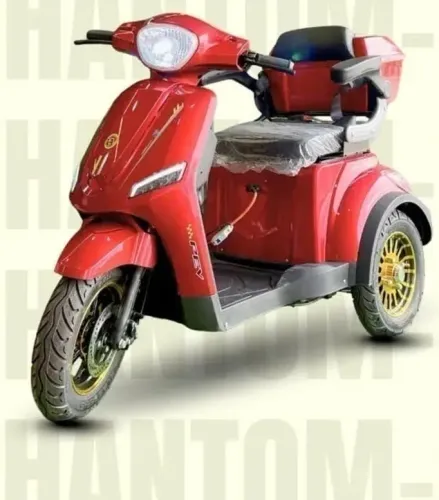
 | Electric Three Wheeler PHANTOM S ₹105000 The Phantom Electric Three-Wheeler is designed for comfort, safety, and convenience. |
 | Electric Three Wheeler PHANTOM D ₹107000 The Phantom Electric Three-Wheeler is designed for comfort, safety, and convenience. |
Frequently asked questions
Can a wheelchair user ride a Cherry scooty without leaving the wheelchair?
No. A conventional Cherry S or Cherry D scooty seat requires the rider to transfer from the wheelchair, bed, standing position or walking aid.
What physical abilities should you assess before buying?
Check whether the rider can transfer onto the seat, sit securely, operate every control and dismount without unavailable assistance.
What should you verify about a Cherry electric three-wheeler in Pune?
Verify the vehicle category, registration requirements, control layout, seat height, step-through access, dimensions, turning space and payload.
How should you test a Cherry scooty on Pune roads?
Carry the rider’s mobility aid and test storage, balance, braking, turning, slopes, potholes and traffic conditions on the intended daily route.
What should you plan before buying for daily travel?
Confirm charging access, realistic route range, charging time, maintenance support, spare parts availability and recovery arrangements.